Achilles Tendon Rupture: Surgery or No Surgery?
Both paths can work. What the trials say about re-rupture, complications and rehabilitation, and how the choice is made for an individual person.
Medically reviewed by Efe Ozturk, DPM · Last reviewed
Published 6 min read
A torn Achilles tendon is one of the few foot and ankle injuries where “operate or not” is a genuine, evidence-based debate. The tendon joins the calf muscles to the heel bone, and it can tear partly or completely.[2] This article sets out what each path involves, what the trials found, and the questions that decide the choice. For the operation itself, see Achilles tendon surgery; for the condition, Achilles tendon injuries.
First, get it looked at
A rupture is often felt as a sudden pop or stab at the back of the ankle, followed by difficulty pushing off and walking. It needs prompt evaluation.[3] A foot and ankle surgeon can usually confirm it with a hands-on examination, sometimes with an MRI.[3] Delay matters for a practical reason: when a rupture is not treated promptly, the tendon ends pull apart and the gap fills with scar, and repair may then require a tendon transfer or graft.[4] You do not have to decide about surgery on the day of the injury, but the evaluation should not wait.
The two paths
Non-surgical treatment holds the tendon still while it heals, using a boot, brace or cast, and is followed by physical therapy. It avoids the risks of an operation, and it has generally been linked to a higher rate of second ruptures.[3]
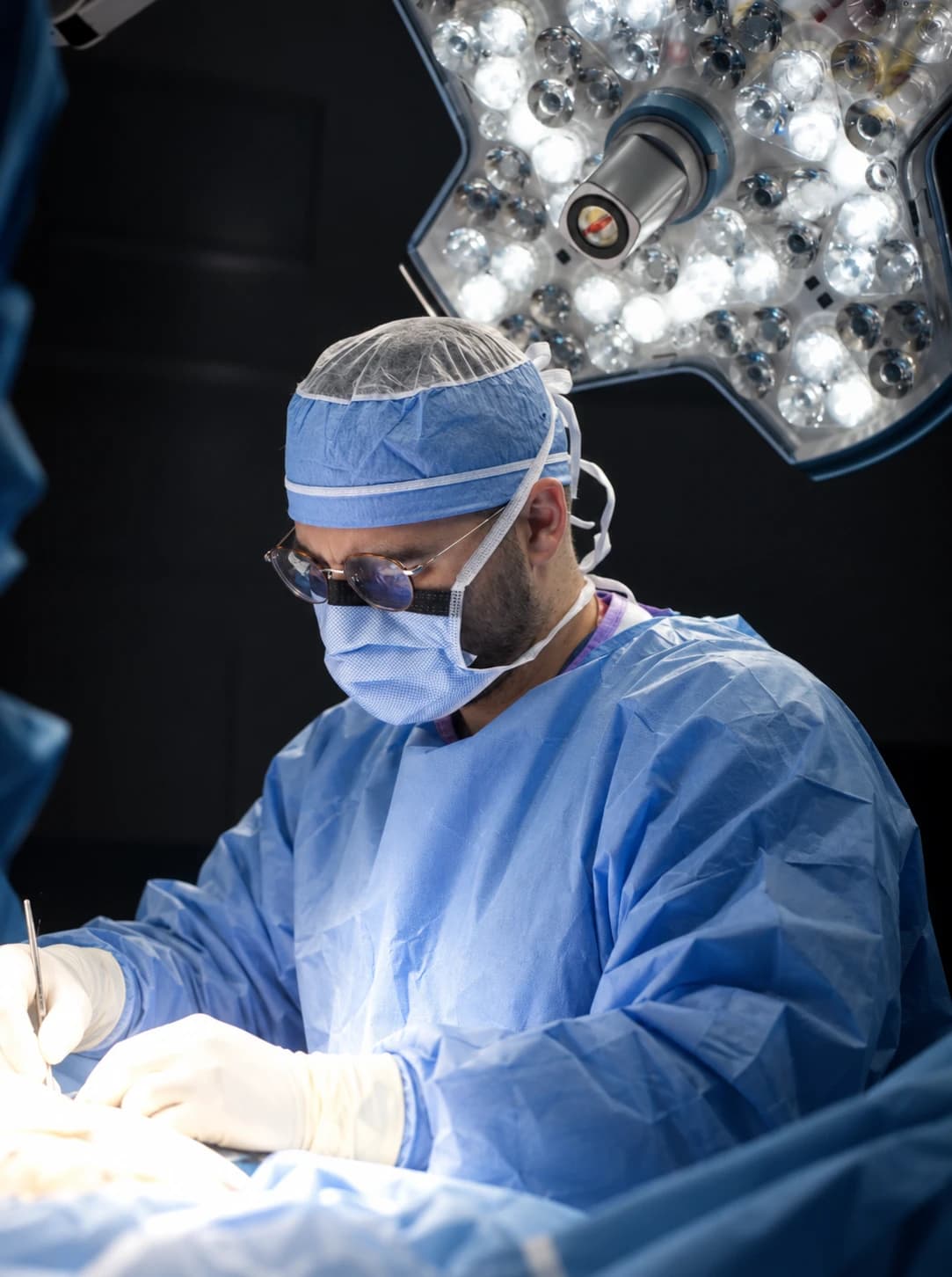
Surgery repairs the torn ends with strong stitches, through an open incision or through smaller incisions. It is generally recommended for active people who want the lowest chance of re-rupture and the strongest push-off, and it is usually done as an outpatient procedure.[3]
What the evidence shows
The comparison has changed over the years because rehabilitation has changed. Older studies kept the leg in a cast without weight for weeks; newer ones move the ankle and bear weight early in a brace. That change narrows the gap.
- Large meta-analysis (10 randomized trials and 19 observational studies). Re-rupture occurred in 2.3% after surgery and 3.9% without, a difference of 1.6 percentage points. Complications occurred in 4.9% compared with 1.6%, mainly infection. In studies with accelerated functional rehabilitation, the difference in re-rupture was not statistically significant. The authors called the differences small.[1]
- A randomized trial of 144 people, in which both groups followed accelerated rehabilitation with early weight-bearing and movement, found no clinically important difference in strength, motion, calf size or a functional score. Re-rupture occurred in two operated patients and three non-operated ones. There were more complications after surgery, mostly soft-tissue problems.[5]
| Measure | Surgery (72 people) | Non-surgical care (72 people) |
|---|---|---|
| Re-rupture | 2 | 3 |
| Complications | 13, mainly soft-tissue related | 6 |
| Strength, motion, calf size, functional score | No clinically important difference | No clinically important difference |
The trial authors concluded that accelerated rehabilitation without surgery gave acceptable results and avoided serious complications related to surgery.[5] An evidence-based clinical guideline on operative treatment takes a more cautious tone: a well-designed surgical plan supports early recovery, but the indications, timing, choice of technique and rehabilitation protocol remain debated.[6]
If you choose surgery: open or minimally invasive?
Repair can be done through one incision over the back of the lower leg, or through smaller incisions. A meta-analysis of 10 randomized trials (522 patients) found similar function with both. Superficial infection was more common after open repair (6.0% compared with 0.4%), while injury to the sural nerve, which supplies sensation to the outer foot, was reported only after minimally invasive repair (3.4%). Total complications and re-rupture did not differ significantly.[7]
What recovery looks like
Rehabilitation is central whichever path you take. After surgery, starting motion and weight-bearing early in a brace or boot was as safe as a cast. It gave higher patient satisfaction and a faster return to prior sports level in most trials, with no difference in major complications. By six months, strength differences were negligible.[8]
Other practical points:
- Driving. After open repair of the right Achilles tendon, brake response time returned to normal at about six to seven weeks in one study, and 54 of 59 people passed at six weeks. Ask your surgeon before you drive. See when can I drive after foot or ankle surgery?[9]
- Blood clots. Keeping the leg immobilized raises the risk of clots in the leg veins, and your surgeon will discuss your own risk and whether preventive measures are appropriate.[10,11]
- Preparation. If you are having surgery, how to prepare for foot and ankle surgery has a checklist, and recovery after foot and ankle surgery covers the stages.
What tips the decision
There is no single right answer, and reasonable surgeons and patients choose differently. The factors that usually matter are:
- Your goals and activity level. Surgery is generally recommended for active people who want the lowest chance of re-rupture and the strongest push-off.[3]
- Your health. Conditions that affect wound healing, such as diabetes, smoking and poor circulation, count for more when surgery is on the table, because infection accounted for most of the extra complications after surgery in the large meta-analysis.[1]
- Timing. How long ago the tear happened, and whether the tendon ends can still be brought together, affect both options.[4]
- Your tolerance for risk and for a second rupture. A 1.6 percentage point difference in re-rupture will matter more to some people than others, as will a 3.3 point difference in complications.[1]
- Whether a reliable rehabilitation program is available for the path you choose.
Questions to ask your surgeon
- Am I a candidate for non-surgical treatment, and how would the risks compare for me?
- If you recommend surgery, which technique and why?
- How soon can I put weight on the foot, and what will physical therapy involve?
- How do my other health conditions change the risks?
- What happens if I wait, or if the tendon ruptures again?
Common questions
Can a torn Achilles heal without surgery?
Yes. Non-surgical treatment with a boot, brace or cast followed by rehabilitation is an established option, and one randomized trial found clinically similar results to surgery when both groups used accelerated rehabilitation.[3,5]
How likely is a second rupture?
In the large meta-analysis, about 2.3% after surgery and 3.9% without it, with no significant difference in studies that used early functional rehabilitation.[1]
Is surgery better for athletes?
Surgery is generally recommended for active people who want the lowest chance of re-rupture and the strongest push-off, but it is an individual decision.[3]
How long until I can return to sport?
It takes many months, and it depends on your strength and your surgeon’s clearance. After surgery, early rehabilitation in a brace brought a faster return to the previous sports level in most trials, and strength differences were negligible by six months.[8]
What if I don’t get treated for weeks?
A delayed or neglected rupture can be harder to repair, and may need a tendon transfer or graft.[4] See a foot and ankle surgeon promptly.
The bottom line
A ruptured Achilles is a real decision, and both choices are supported by evidence. Surgery lowers the small chance of a second rupture and adds a small chance of a complication; non-surgical care with early rehabilitation avoids surgery and gives similar function in trials. Get evaluated quickly, then choose with a surgeon who lays out both.
Reviewing surgeon
Foot and Ankle Surgeon at Center for Lower Extremity Surgery, a specialty practice of Ozturk Foot & Ankle. Dr. Ozturk is double board certified, as a Diplomate of the American Board of Podiatric Medicine (DABPM) and a Fellow of the Academy of Physicians in Wound Healing (FAPWH), and is a Fellow of the American Society of Podiatric Surgeons (FASPS) and the American Society of Podiatric Medicine (FASPM).
References
- 1.Ochen Y, Beks RB, van Heijl M, Hietbrink F, Leenen LPH, van der Velde D, et al. Operative treatment versus nonoperative treatment of Achilles tendon ruptures: systematic review and meta-analysis. BMJ. 2019;364:k5120. PubMed 30617123 (external site)
- 2.Shamrock AG, Dreyer MA, Varacallo MA. Achilles Tendon Rupture. In: StatPearls. StatPearls Publishing; updated 2023. PubMed 28613594 (external site)
- 3.American College of Foot and Ankle Surgeons. Achilles Tendon Rupture. FootHealthFacts. foothealthfacts.org (external site)
- 4.Feng SM, Maffulli N, Oliva F, Saxena A, Hao YF, Hua YH, et al. Surgical management of chronic Achilles tendon rupture: evidence-based guidelines. J Orthop Surg Res. 2024;19(1):132. PubMed 38341569 (external site)
- 5.Willits K, Amendola A, Bryant D, Mohtadi NG, Giffin JR, Fowler P, et al. Operative versus nonoperative treatment of acute Achilles tendon ruptures: a multicenter randomized trial using accelerated functional rehabilitation. J Bone Joint Surg Am. 2010;92(17):2767-2775. PubMed 21037028 (external site)
- 6.Feng SM, Maffulli N, Oliva F, Paul C, Fehske K, Plaass C, et al. Evidence-based clinical practice guidelines on the surgical management of acute Achilles tendon rupture. Br Med Bull. 2026;157(1). PubMed 41528729 (external site)
- 7.Attia AK, Mahmoud K, d'Hooghe P, Bariteau J, Labib SA, Myerson MS. Outcomes and Complications of Open Versus Minimally Invasive Repair of Acute Achilles Tendon Ruptures: A Systematic Review and Meta-analysis of Randomized Controlled Trials. Am J Sports Med. 2023;51(3):825-836. PubMed 34908499 (external site)
- 8.McCormack R, Bovard J. Early functional rehabilitation or cast immobilisation for the postoperative management of acute Achilles tendon rupture? A systematic review and meta-analysis of randomised controlled trials. Br J Sports Med. 2015;49(20):1329-35. PubMed 26281836 (external site)
- 9.Reb CW, McDonald E, Shakked RJ, Winters BS, Pedowitz DI, Raikin SM, et al. Brake Response Time Recovery After Achilles Tendon Repair. Foot Ankle Spec. 2020;13(3):188-192. PubMed 31014108 (external site)
- 10.Mangwani J, Sheikh N, Cichero M, Williamson D. What is the evidence for chemical thromboprophylaxis in foot and ankle surgery? Systematic review of the English literature. Foot (Edinb). 2015;25(3):173-8. PubMed 26092561 (external site)
- 11.Zee AA, van Lieshout K, van der Heide M, Janssen L, Janzing HM. Low molecular weight heparin for prevention of venous thromboembolism in patients with lower-limb immobilization. Cochrane Database Syst Rev. 2017;8(8):CD006681. PubMed 28780771 (external site)
This article is general health information and isn’t a substitute for advice from a clinician who knows your history. Read our medical disclaimer and how we review content.
Learn more about this
Treatment
Achilles tendon repair
Sewing a ruptured Achilles tendon back together, or treating a long-standing tendon problem, and what recovery involves.
Condition
Achilles tendon injuries
Pain or thickening of the tendon behind the heel, or a partial or complete tear.
Treatment
Recovery after surgery
Weight-bearing, swelling, timelines by operation, driving, work and the warning signs to watch for.
Keep reading
Before and after surgery
When Can I Drive After Foot or Ankle Surgery?
The answer depends on which foot was operated on, what you are wearing and what you are taking. What research on braking shows, and how to decide.
6 min read
Before and after surgery
How to Prepare for Foot and Ankle Surgery: A Checklist
A practical checklist for the weeks before surgery: your health review, the risks you can change, setting up your home, and what to bring.
7 min read
Heel, arch and tendons
Plantar Fasciitis Surgery: When It’s an Option
Most heel pain improves without an operation. When it has not, here is what surgery involves, what the evidence shows, and what to check first.
6 min read
On the Ozturk Foot & Ankle blog
General foot care and non-surgical basics, from our parent practice.