Insertional Achilles Surgery: Heel Spur Removal, Tendon Reattachment and Return to Sport
When pain where the Achilles meets the heel lasts despite good care, surgery removes the spur and diseased tendon and reattaches the tendon. Across 16 studies, 89.6% had good or excellent results.
Medically reviewed by Dr. Efe Ozturk · Last reviewed
Published 6 min read
The Associated Press reported on September 29 that Los Angeles Clippers forward Brandon Ingram had surgery on his right heel in May, and that doctors found and treated a partially torn Achilles tendon during that operation.[4] On November 6, 2026, he had advanced to full-contact practice and said he was close to returning.[5,6] The Athletic’s Law Murray reported on November 7 that he would sit out the November 8 game against New Orleans.[7] Separately, the AP reported on November 6 that San Francisco 49ers receiver Mike Evans would miss a second straight game with Achilles tendinitis.[8] Reports have not described exactly what was done in Ingram’s operation, and Evans has not been reported to need surgery. We have no connection with these athletes or their teams and have not examined them. The studies below describe other patients, not a forecast for anyone in the news.
What is insertional Achilles tendinopathy?
It is wear and irritation of the lower end of the Achilles tendon, where it meets the heel bone. Runners are most often affected, a tight calf adds strain, and bone spurs often form at the back of the heel.[1] A prominent upper corner of the heel bone, called a Haglund deformity, can press on the tendon too; see Haglund deformity.
When is insertional Achilles surgery recommended?
Exercise, shoe changes and other care come first. Nonsurgical care is the usual first step, and 10% to 30% of patients eventually need an operation.[2] A review of 54 studies with 2,177 patients found that removing diseased tendon, the inflamed bursa (a fluid sac behind the heel) and the heel spur is effective.[9] When a partial tear near the attachment does not settle, surgeons can remove the torn part and repair it, sometimes with anchors.[10]
Seeing a Foot and Ankle Surgeon early matters, because the amount of tendon damage shapes the operation and the recovery. More damage means a longer recovery.[1]
What happens during insertional Achilles repair?
The operation is tailored to how much of the tendon is diseased.[11,12]
- Getting to the spur. One route is an incision down the back of the heel that splits the tendon down its center. Others release the tendon from one side or detach it completely.[13]
- Heel spur and Haglund removal. The spur and the prominent heel bone are shaved down so they no longer rub the tendon.[9]
- Debridement. Diseased tendon tissue is cut away.[1]
- Reattachment. The healthy tendon is fixed back to the heel with suture anchors (small implants that hold stitches in bone).[1] A double-row repair, with two rows of anchors, held more load in some lab tests.[14] In 110 patients, though, it had no fewer complications or revisions than a single anchor.[15]
- FHL transfer when needed. The flexor hallucis longus (FHL), the tendon that bends the big toe, can be moved to the heel to boost push-off when more than half of the Achilles is removed.[1] In 30 patients grouped by MRI, those with more than 50% degeneration who had the transfer scored higher on an Achilles-specific function measure at one year than those with less damage treated without it, with no more wound problems.[16]
For bump removal through small incisions, and the Zadek osteotomy (a wedge cut in the heel bone), see Haglund deformity surgery. For a full or chronic tear, see Achilles tendon surgery.
What results do studies show?
| Study | Patients | What was found |
|---|---|---|
| Review of 16 studies | 465 | 89.6% good or excellent |
| Central tendon-splitting approach, 2 years | 75 | Scores 46 to 95 out of 100; pain 6.7 to 0.55; 94.3% satisfied |
| Midline approach, 4 years | 118 | Foot Function Index (lower is better) 53 to 2 |
| Surgery tailored to tendon damage | 46 | Scores 62 to 94; 71.7% same or higher sport level |
| FHL transfer, patients over 50 | 20 | All scores improved; all returned to daily activities |
Sources: one review and four case series.[2,3,17,12,18]
Insertional Achilles surgery recovery timeline
- First 2 weeks. Many patients walk in a removable boot or cast within about 2 weeks.[1] In 29 heels operated on for insertional tendinopathy with a Haglund bump and moved early on a rupture-style rehab plan, average pain fell from 6.1 to 1.5 out of 10.[19]
- About 3 months. In 22 patients after open spur removal and reattachment, all went back to their previous work, at an average of 3.3 months.[20]
- 5 to 6 months. The 70% who got back to their previous sport level did so at an average of 5.1 months.[20] In 25 athletes after open debridement and Haglund removal, 92% returned to sport, at an average of 6.1 months.[21]
- Up to a year. Full recovery can take up to 12 months of rehabilitation.[1]
See recovery after foot and ankle surgery and our stage-by-stage Achilles recovery guide.
Can athletes return to sport after insertional Achilles surgery?
Yes, most do. After surgery tailored to the degree of tendon damage, 71.7% of 46 patients played at the same or a higher level.[12] After open repair, 70% of 22 patients returned to their previous sport.[20] In athletes, a small-incision Zadek osteotomy returned 25 of 25 to sport at about 4.3 months, compared with 23 of 25 at 6.1 months after open surgery, and function was similar by 18 months.[21]
Is there a smaller option first?
For tendinopathy that has not settled, our parent practice offers Tenex, a needle-sized procedure that removes damaged tendon through a tiny incision; see Tenex for Achilles tendonitis (external site). Removing a large spur or Haglund bump, or reattaching the tendon, takes the operation described here.
What are the limits?
Most evidence comes from retrospective case series, and no single technique has been shown to be superior.[2,11] The average complication rate was 18.3%, mostly minor.[2] Across 17 studies, wound problems ranged from 0% to 2.8% and ruptures from 0.7% to 2.6% depending on the approach.[13] In 100 midline detach-and-reattach operations, 4% needed revision for rupture or pull-off and 9% had wound problems.[22] Between 20% and 30% of patients still have some pain, and up to 47% had residual symptoms at four years in one series.[1,17]
Common questions
What is the recovery time for insertional Achilles surgery?
Many people walk in a boot within about 2 weeks, return to work around 3 months and to sport around 5 to 6 months, with full recovery taking up to a year.[1,20]
What is insertional Achilles repair?
The surgeon removes the spur and damaged tendon, then fixes the healthy tendon back to the heel bone with anchors.[1]
What is the Haglund’s surgery recovery timeline?
After open bump removal with tendon reattachment, patients returned to work at about 3.3 months, and most returned to sport at about 5.1 months.[20]
Will I need a tendon transfer?
Usually only if more than half of the tendon must be removed.[1]
The bottom line
When insertional Achilles pain lasts despite good nonsurgical care, removing the spur and diseased tendon and reattaching the tendon gives most people lasting relief and a return to activity. Which approach fits your heel is a decision Dr. Ozturk makes after examining it and reviewing your imaging. Dr. Ozturk is a double board certified Foot and Ankle Surgeon and podiatrist who sees patients in Lyndhurst, Paramus and Millburn. Read about Achilles tendon injuries, or request an appointment.
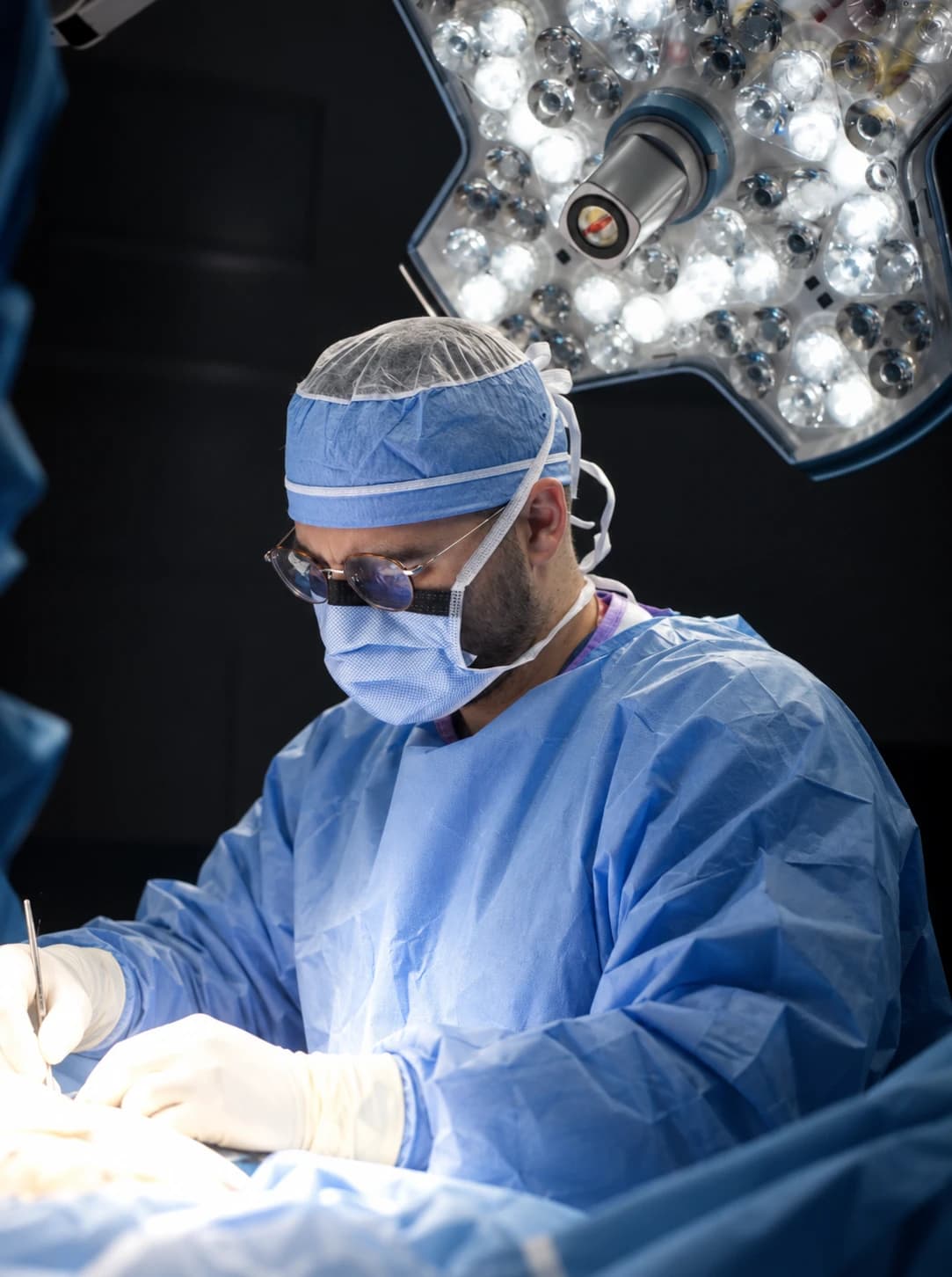
Reviewing surgeon
Foot and Ankle Surgeon at Center for Lower Extremity Surgery, a specialty practice of Ozturk Foot & Ankle. Dr. Ozturk is double board certified, as a Diplomate of the American Board of Podiatric Medicine (DABPM) and a Fellow of the Academy of Physicians in Wound Healing (FAPWH), and is a Fellow of the American Society of Podiatric Surgeons (FASPS) and the American Society of Podiatric Medicine (FASPM).
References
- 1.American Academy of Orthopaedic Surgeons. Achilles Tendinitis. OrthoInfo. orthoinfo.org (external site)
- 2.Traina F, Perna F, Ruffilli A, et al. Surgical treatment of insertional Achilles tendinopathy: a systematic review. J Biol Regul Homeost Agents. 2016;30(4 Suppl 1):131-138. PubMed 28002910 (external site)
- 3.Tay AYW, Goh GS, Li Z, Yeo NEM, Tay KS. Two-year clinical and radiologic outcomes following surgical treatment of insertional Achilles tendinopathy using a central tendon-splitting approach. Foot Ankle Int. 2023;44(8):702-709. PubMed 37272028 (external site)
- 4.Harris B. Brandon Ingram’s Clippers debut on hold after heel surgery, partial Achilles tear. Associated Press via NBA.com. Published September 29, 2026. nba.com (external site)
- 5.RotoWire Staff. Clippers’ Brandon Ingram: Nearing return. CBS Sports. Published November 6, 2026. cbssports.com (external site)
- 6.Basketnews. Clippers star gives positive injury update. Published November 6, 2026. basketnews.com (external site)
- 7.RotoWire Staff, citing Law Murray of The Athletic. Brandon Ingram injury: Remains out Sunday. RotoWire. Published November 7, 2026. rotowire.com (external site)
- 8.Associated Press. Receiver Mike Evans will miss his 2nd straight game for the 49ers with Achilles tendinitis. Fox Sports. Published November 6, 2026. foxsports.com (external site)
- 9.Jarin IJ, Bäcker HC, Vosseller JT. Functional outcomes of insertional Achilles tendinopathy treatment: a systematic review. JBJS Rev. 2021;9(6):e20.00110. PubMed 34125735 (external site)
- 10.Gatz M, Spang C, Alfredson H. Partial Achilles tendon rupture: a neglected entity. A narrative literature review on diagnostics and treatment options. J Clin Med. 2020;9(10):3380. PubMed 33096900 (external site)
- 11.Moen R, Hagenbucher JR, Shinabarger AB. Surgical treatment of insertional Achilles tendinopathy: a systematic review. J Am Podiatr Med Assoc. 2020;110(5):Article_5. PubMed 33179068 (external site)
- 12.Hardy A, Rousseau R, Issa SP, et al. Functional outcomes and return to sports after surgical treatment of insertional Achilles tendinopathy: surgical approach tailored to the degree of tendon involvement. Orthop Traumatol Surg Res. 2018;104(5):719-723. PubMed 29852319 (external site)
- 13.Thompson JM, Nguyen K, Ahluwalia J, et al. Surgical takedown approaches to insertional Achilles tendinopathy: a systematic review. J Foot Ankle Surg. 2021;60(6):1217-1221. PubMed 34108118 (external site)
- 14.Ramelli L, Docter S, Kim C, Sheth U, Park SS. Single-row repair versus double-row repair in the surgical management of Achilles insertional tendinopathy: a systematic review. Orthop J Sports Med. 2024;12(8):23259671241262772. PubMed 39143983 (external site)
- 15.DeVries JG, Scharer BM. Double row fixation is more costly and does not have clinical benefit over single anchor for insertional Achilles tendon surgery. J Foot Ankle Surg. 2023;62(4):618-622. PubMed 36737321 (external site)
- 16.Ateş G, Korkut SB, Vural A, Tokgöz MA, Özer H. Surgical outcomes of insertional Achilles tendinopathy: a comparison of techniques with and without FHL transfer. J Foot Ankle Surg. 2026;65(5):168.e1-168.e6. PubMed 42162683 (external site)
- 17.Hörterer H, Oppelt S, Böcker W, et al. Patient-reported outcomes of surgically treated insertional Achilles tendinopathy. Foot Ankle Int. 2021;42(12):1565-1569. PubMed 34154453 (external site)
- 18.Singh MS, Harna B, Singh S, Vishwakarma G. Evaluation of flexor hallucis tendon transfer in chronic insertional Achilles tendinopathy in over 50-year-old population using validated ankle scores. Foot (Edinb). 2023;54:101969. PubMed 36805957 (external site)
- 19.Vesely BD, Reardon BK, Scott AT, Medda AW. Early outcomes with early weightbearing using Willits protocol following Haglund’s surgery. J Am Podiatr Med Assoc. 2025;115(3):23-002. PubMed 40569850 (external site)
- 20.Lai Wei Hong S, Tang Qian Ying C, Thwin L, Thevendran G. Return to sport and physical activity after calcaneoplasty for insertional Achilles tendinosis. J Foot Ankle Surg. 2016;55(6):1190-1194. PubMed 27600485 (external site)
- 21.Genuth G, Stavrou P, Brown C, Iselin LD. Minimally invasive Zadek osteotomy vs open Achilles debridement for insertional Achilles tendinopathy in athletes: a retrospective comparative cohort study. Foot Ankle Int. Published online November 2, 2026. PubMed 42973118 (external site)
- 22.McAlister JE, Hyer CF. Safety of Achilles detachment and reattachment using a standard midline approach to insertional enthesophytes. J Foot Ankle Surg. 2015;54(2):214-219. PubMed 25619811 (external site)
This article is general health information and isn’t a substitute for advice from a clinician who knows your history. Read our medical disclaimer and how we review content.
Learn more about this
Treatment
Haglund deformity surgery
Removing the bony bump on the back of the heel and cleaning up the inflamed tissue, open or with an endoscope.
Condition
Haglund deformity
A bony bump on the back of the heel that rubs against the shoe and irritates the Achilles tendon.
Treatment
Achilles tendon repair
Sewing a ruptured Achilles tendon back together, or treating a long-standing tendon problem, and what recovery involves.
Condition
Achilles tendon injuries
Pain or thickening of the tendon behind the heel, or a partial or complete tear.
Treatment
Recovery after surgery
Weight-bearing, swelling, timelines by operation, driving, work and the warning signs to watch for.
Keep reading
Heel, arch and tendons
Achilles Tendon Surgery Recovery: A Stage-by-Stage Timeline
Repair lowers the chance of a second tear, and 77% returned to sport in one review. Why it is worth a year of recovery, and the road back stage by stage.
7 min read
Heel, arch and tendons
Achilles Tendon Rupture: Surgery or No Surgery?
Both paths can work. What the trials say about re-rupture, complications and rehabilitation, and how the choice is made for an individual person.
6 min read
Before and after surgery
How to Prepare for Foot and Ankle Surgery: A Checklist
A practical checklist for the weeks before surgery: your health review, the risks you can change, setting up your home, and what to bring.
7 min read
On the Ozturk Foot & Ankle blog
General foot care and non-surgical basics, from our parent practice.